For homeowners
Core Drilling for Your Home
Need a hole for an extractor fan, boiler flue or soil pipe? Core drilling makes a clean, round hole through brick, block or concrete, without hammering your wall apart.
In plain English
What is core drilling?
Core drilling uses a drill bit shaped like a hollow tube, with diamonds set into its cutting edge. It cuts a ring through the wall and the middle comes out as a solid plug, called the core. You’re left with a neat, round hole with smooth sides.
Bashing a hole through with a hammer drill and chisel can crack bricks, blow plaster off the other side and leave a ragged hole to patch. A core drill is held steady on a stand, so the hole is straight, the right size, and clean on both faces.
If your fitter has told you to “get a core drilled”, this is what they mean. If you’re not sure what size or where, ask them to mark it on the wall, or just send us a photo.
Common jobs at home
What homeowners need drilled
Extractor fans
A round hole through an outside wall for a kitchen or bathroom fan duct, sized to the duct so it fits snugly.
Boiler flues
A hole for a new or moved boiler’s flue. Your Gas Safe engineer tells us the size and position; we drill it, they fit the flue.
Soil and waste pipes
Holes through walls or floors for a new bathroom, toilet or kitchen sink, often at an angle so the pipe falls the right way.
Extensions and alterations
New pipe and cable routes through existing walls when you extend or knock through, so services can reach the new space.
More detail: core drilling through walls and drilling through concrete floors.
On the day
What happens when we drill
Step 1: Set up
The position is marked and the drill rig is set up against the wall or on the floor.
Step 2: Drill
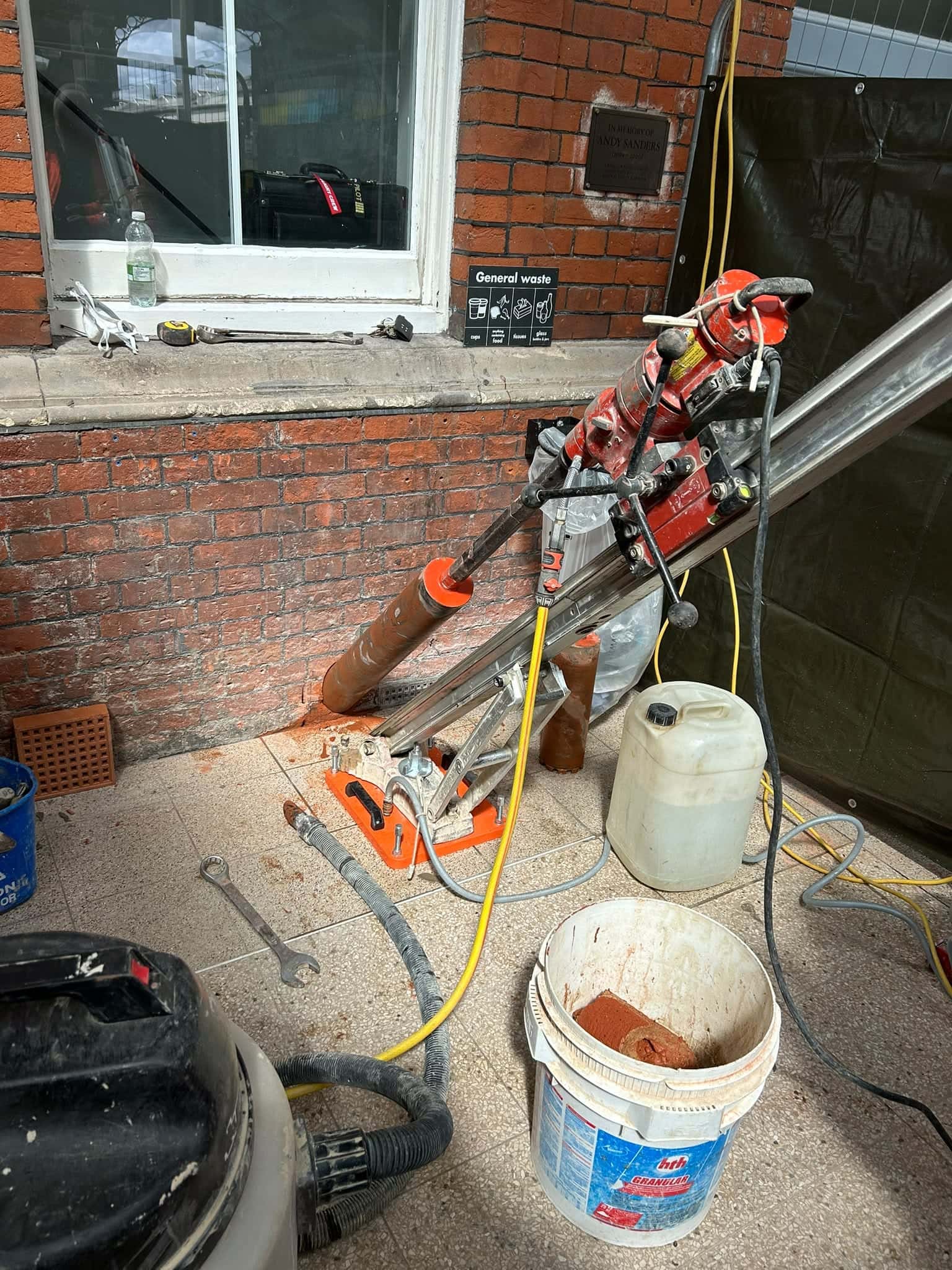
Core drilling is usually done wet: water runs through the bit to keep it cool and comes out as a grey slurry.
Step 3: Core out
The core comes out in one piece, or a few on a thick wall. The hole is ready for your fitter.
Step 4: Clear up
The slurry is collected with a wet vac as the work goes, and the cores go into buckets.
Straight answers
Mess, noise and cost
Mess
Core drilling is usually done wet, so there’s far less dust than hammering a hole through. The trade-off is water and slurry, which is why our photos show collectors, wet vacs and buckets right next to the drill.
Noise
It’s a steady grinding sound, like a large power tool, rather than the banging of a hammer drill. It’s loud while the bit is cutting, then stops.
Cost
The price depends on the size and number of holes, what the wall is made of, how thick it is and how easy it is to get to. A photo and a rough size are usually enough to start. Ask us for a quote.
Who you’re dealing with
Direct Core Drilling is a limited company registered in England and Wales (company number 06543791). We do diamond core drilling, and that’s all we do. More about us.
Not sure what you need? Send a photo.
Take a photo of the wall or floor and tell us what’s going through it. We’ll tell you what’s involved and what it costs.